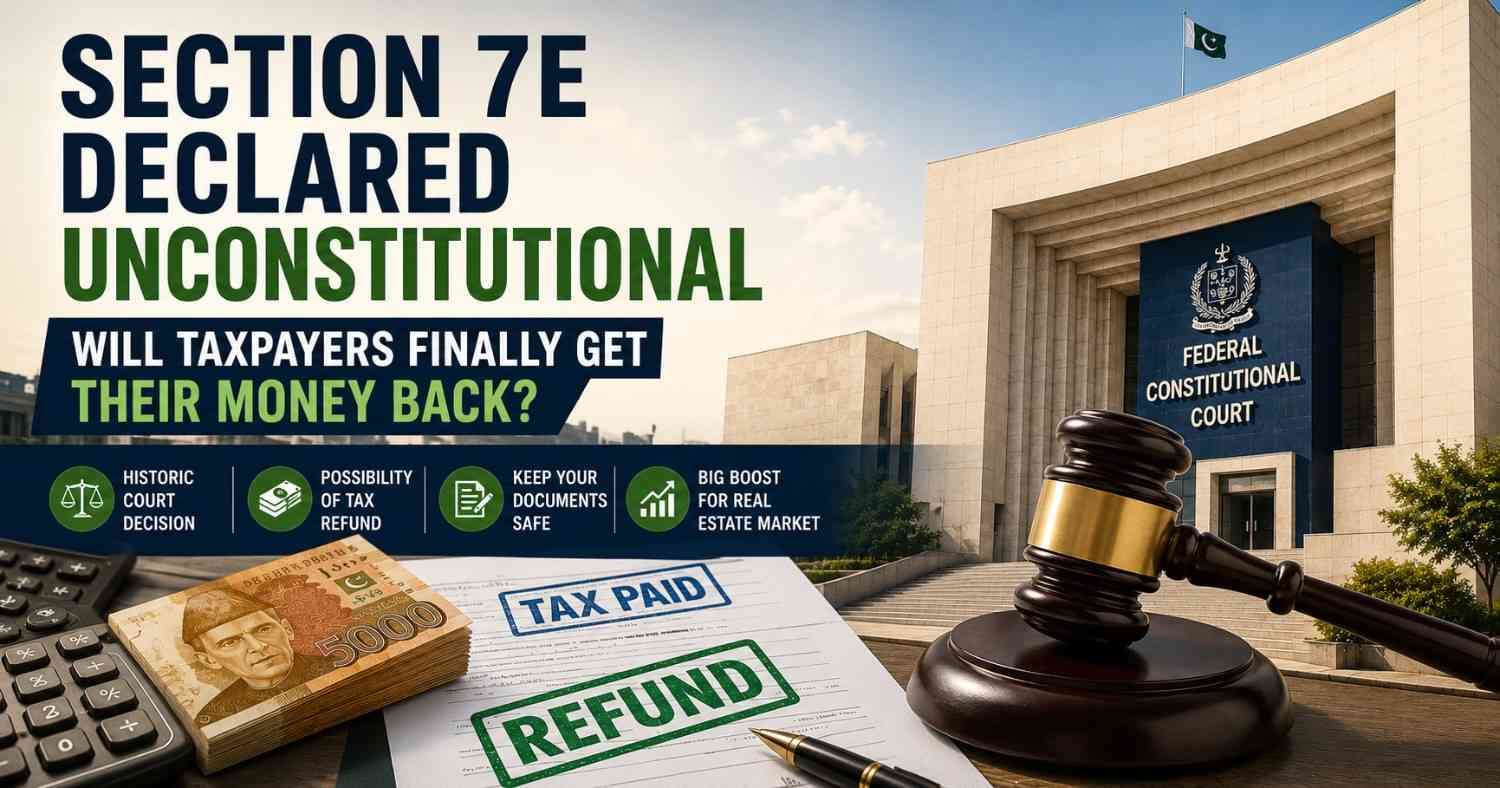
The recent historic decision by Pakistan’s Federal Constitutional Court has brought major relief to taxpayers who have been burdened by Section 7E over the past few years. By declaring the law unconstitutional, the court has not only eased pressure on property owners but also sparked an important nationwide debate:
Will the tax collected since 2022 now be refunded to taxpayers?
Why This Decision Matters
This is not just a legal discussion; it is a matter involving the hard-earned money of thousands of people. When the country’s highest court strikes down a law entirely, the tax collected under that law can, in principle, be considered an unlawful recovery.
However, one critical legal question still remains unanswered:
- Will the judgment apply retrospectively from 2022?
- Or will it only affect future tax collections?
The answer will become clearer once the detailed judgment is officially released. Until then, any conclusions would be premature.
Can Taxpayers Claim a Refund?
If the court’s ruling is applied retrospectively, taxpayers may have a strong legal basis to recover the amounts paid under Section 7E since 2022.
However, the practical side of the process may not be so simple.
The Federal Board of Revenue (FBR) is generally known for lengthy and complex refund procedures. In many similar cases, authorities either:
- Challenge the court’s ruling,
- Delay implementation, or
- Introduce procedural requirements that make refunds difficult for ordinary taxpayers.
As a result, recovering the money may require patience, proper documentation, and formal legal compliance.
Important Steps for Property Owners
If you paid tax under Section 7E during a property sale or transfer, you should immediately organize and preserve the following documents:
- Tax challans
- Payment receipts
- Property transfer records
- Income tax returns
- FBR correspondence, if any
These records could become essential if the government opens an official refund process.
What Legal Experts Are Saying
According to legal and tax experts, the possibility of refunds is no longer just speculation. The court’s decision has moved the issue much closer to reality.
However, taxpayers will most likely need to:
- File a formal refund claim,
- Follow procedures under Pakistan’s income tax laws, and
- Monitor upcoming FBR notifications and implementation guidelines carefully.
Big Impact on Pakistan’s Real Estate Market
The ruling could also have a significant positive impact on Pakistan’s property sector.
Section 7E had become a major hurdle in real estate transactions, increasing costs and creating uncertainty for buyers and sellers. With this burden potentially removed, the market may now experience:
- Increased property transactions,
- Improved investor confidence,
- Greater market activity, and
- Renewed momentum in the real estate sector.
The court’s decision against Section 7E is being viewed as a landmark moment for taxpayers and the real estate industry in Pakistan. While the possibility of refunds looks promising, the final outcome will depend on the detailed judgment and how the government and the FBR choose to implement it.
For now, taxpayers should stay informed, keep their financial records safe, and be prepared for any official refund procedure that may be announced in the coming weeks.

Tags